
"There's a Garbage Truck!"
-K (5 YRS)
Documentation helps makes learning and thinking visible to everyone. (Giudici et al., 2001)
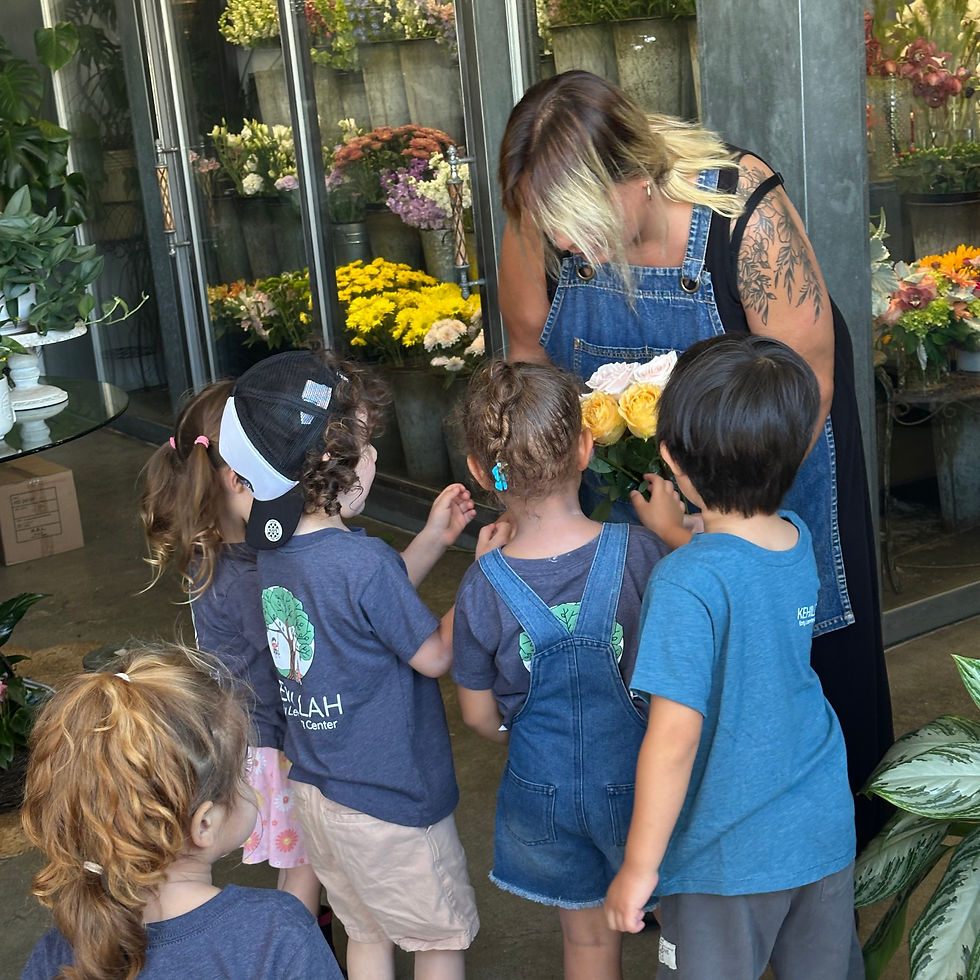


Building Relationships Through Neighborhood Walks
Every Wednesday, our class takes a neighborhood walk that has become an important part of our learning journey. As we navigate the sidewalks, the children strengthen their gross motor skills, balance, and spatial awareness while learning to coordinate their movements and practice safety and self-regulation as a group. By visiting familiar places such as the flower shop and bakery, they build meaningful relationships with the people in our community while developing a strong sense of belonging. In our Reggio philosophy, the community is viewed as an extension of the classroom, offering authentic opportunities for inquiry and connection.
At the flower shop, the children refine their sensory processing and fine motor control as they gently touch delicate petals, smell different blooms, and compare colors, textures, and varieties of plants. This hands-on exploration naturally expands their descriptive vocabulary as they wonder about what plants need to grow and thrive.
At the bakery, they count how many treats are needed, explore mathematical concepts like size, shape, and quantity through real-life experiences, and observe the important roles people play within their community.
Along the way, they notice seasonal changes, landmarks, and spatial patterns, which helps them build early geography skills as they mentally map their neighborhood. These shared experiences encourage the children to collaborate, ask questions, develop theories, and make connections between their observations and classroom investigations. Through repeated visits, they strengthen their expressive language, confidence, empathy, and understanding that learning happens beyond the walls of the school. The relationships they are building with caring adults and familiar places create a foundation for future research and emergent curriculum, reminding us that meaningful learning grows through connection, participation, and authentic experiences.
We wonder, how will these relationships and experiences continue to influence the children's thinking and inspire future investigations?
Special Thanks to our Community Partners


Please support the people who support our kids
Giudici, C., Rinaldi, C., & Krechevsky, M. (Eds.). (2001). Making learning visible: Children as individual and group learners. Reggio Children.


Comments